Execution of Alvar’s Mother
Bride of AlvarExecution of Alvar’s Mother is the decisive early trauma in Alvar’s history: after his family discovers that he carries Cursed blood, his mother is condemned and burned, while Alvar arrives too late to rescue her. The event expels him from his home, fixes his fear that his existence destroys those he loves, and gives his later resistance to Saul’s tyranny a deeply personal origin.
Discovery and Condemnation
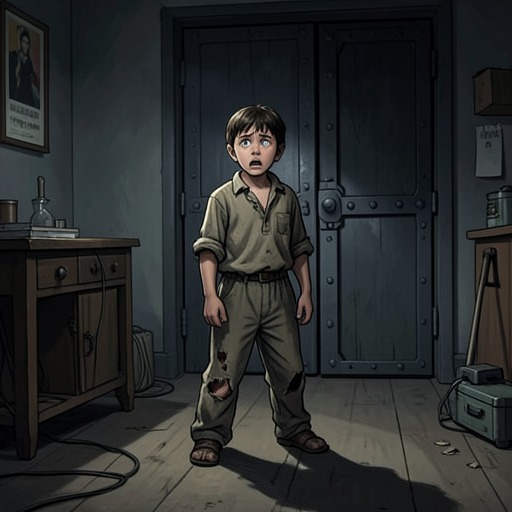
The execution follows the revelation of Alvar’s condition within his family home. Already troubled by his failure to protect the household goats, Alvar tries to tell his parents the truth, knowing that his mother has taught him since childhood that the Cursed are the scourge of Axus. His brother Ashtar exposes him when Alvar’s eyes turn red. His mother responds by taking a knife from the chopping block and threatening to kill him and his Cursed demon, while his father calls him Cursed spawn. Alvar flees rather than attack them and transforms into his Cursed form to escape by flight.
The family’s rejection quickly becomes communal violence. After learning that Alvar has been discovered, Ashtar accuses him of killing their mother, even though the villagers themselves are responsible for the coming execution. Alvar denies the charge aloud, but inwardly accepts a more painful version of it: he believes that his existence has made his mother’s death possible. Villagers spit at him, throw objects, draw swords, and deny that he has ever been human. Their response treats inherited or magical difference as proof of monstrosity, turning a family secret into a public sentence.
The Burning
The villagers burn Alvar’s mother on the Tuesday after his discovery. Although Alvar has already fled, local people carry the news to him. He returns to the execution disguised beneath a stolen priest’s black hood, intending to change forms and save her if necessary. The priests are still chanting when he reaches the site, but the fire has risen as high as the rooftops. All he can see of his mother is a charcoal corpse.
The scene combines religious ritual with irreversible failure. The priests’ chanting frames the killing as sanctioned judgment, while Alvar’s hidden approach shows that he still regards himself as connected to the community he has been expelled from. His arrival too late makes the event more than an execution: it is the collapse of his hope that his abilities can repair every wound. He cannot tell his mother that he is sorry or that he never expected her to love him for what he was, though he still wanted her to be free.
Burial and Exile
When Ashtar shouts that Alvar killed their mother, Alvar answers that the family and villagers killed her. Yet the accusation penetrates him, producing a knot of guilt that he cannot dismiss. As the crowd calls him Cursed scum, Alvar insists that he will not hurt them and that they are his people. The villagers reject even that claim of belonging, warning that he will bring destruction upon them.
Alvar then chooses an act of mourning and defiance. Rather than fly away and abandon the pyre, he changes into his Cursed form, dives into the flames, and takes his mother’s corpse in his claws. He declares that he will bury her if the crowd will not. Ashtar threatens to spit on her grave, but Alvar carries the body away and resolves to place it on a high mountain where no one can spit on or tread upon it. His motive is not sentimental reconciliation: he acknowledges that his mother did not love him, yet she carried and gave birth to him, and he will honor her with a proper grave before leaving for the south, where no one knows his face or nature.
This burial marks Alvar’s first deliberate separation from his former world. Exile is imposed on him through violence, but he gives it ethical shape by refusing to let the crowd define his mother’s remains or his final duty toward her. The Cursed form that terrifies the villagers becomes, in this moment, the means by which Alvar protects the dead and preserves a fragment of familial dignity.
Lasting Consequences
The execution establishes the pattern that governs Alvar’s later life: others interpret his body as a threat, while Alvar struggles to distinguish what he is forced to do from what he chooses. Years later, Saul exploits precisely this vulnerability by placing a Fe collar on him and controlling his transformations and actions. Alvar is made to participate in violence he would not freely choose, including the aftermath of a massacre in which every man in a town but one is dead, yet he continues to treat himself as morally contaminated. His later confession explains that his family cast him out while he was young and that Saul saw his Curse as an instrument for power.
The memory also shapes Alvar’s understanding of love, reproduction, and responsibility. He later admits that Triss died because he impregnated her without understanding how Cursed pregnancies worked, and he calls her death his fault. After researching the condition with multiple record keepers, including Father Ryland, he concludes that Lucy Hammond would not die from bearing his children, though he remains uncertain whether all their children would be Cursed. The earlier execution therefore echoes through his fear that his blood destroys the people who accept him, even when later knowledge offers a possibility of healing that his childhood lacked.
Alvar’s shame is intensified by the fact that he cannot simply discard the past. He has erased memories of Saul’s sexual abuse from the Mystar because he could not bear to revisit them, while retaining other memories of evil committed under coercion as a form of self-punishment. His reluctance to revisit memories of Triss similarly reflects a conflict between mourning and the need to begin a new life. The execution of his mother is the earliest and most absolute version of that conflict: he cannot save the dead, but he can decide whether hatred or honor will govern what he does next.
Narrative Significance
The event is a descent rather than a conventional heroic initiation. Alvar’s separation from home does not begin with a chosen adventure or a mentor’s summons; it begins with bodily exposure, family betrayal, ritualized killing, and the destruction of his place among his own people. His later return to public life reverses the community’s judgment. When he finally tells Underland that he is the monster Saul used to enslave, he identifies himself as both the instrument of Saul’s death-dealing and a captive who had no choice. That confession makes the childhood execution part of a larger struggle over who has the authority to name a person a monster.
The event also clarifies why Alvar’s later use of his Curse can become liberating rather than merely destructive. As a child, he flies from the villagers but returns to the flames for his mother. As an adult, he publicly exposes the Fe collar and his history in order to help free Underland. In both cases, the stigmatized body is turned against the order that condemns or controls it. The mother’s burning remains the wound at the center of that transformation: Alvar’s first failure to save someone he loved becomes the memory through which he measures guilt, duty, resistance, and the possibility of redemption.